Awareness article · Pulmonology
World COPD Day 2026Early Diagnosis and Management for a Better Life
11 min readDr. Chaitanya Kappagantu
COPD develops quietly. A morning cough, slower walking, and extra mucus are easy to explain away until stairs become a struggle. World COPD Day 2026 is a reminder that earlier diagnosis, and steady management, can mean a better life. COPD cannot be cured. It can be recognised sooner, and lived with more comfortably.
Educational information for patients and families. It is aligned with GOLD guidance and is not a personal diagnosis or a treatment plan.
This year's focus
Find COPD early. Manage it properly. Protect the breathing you still have.
What is COPD?
COPD means chronic obstructive pulmonary disease. It is a long-term lung condition. The breathing tubes stay inflamed and narrow, and the tiny air sacs can be damaged. Air becomes hard to empty, so the next breath in starts before the last one has fully left. People notice this as cough, mucus, wheeze, and breathlessness.
The Global Initiative for Chronic Obstructive Lung Disease (GOLD) describes COPD as ongoing respiratory symptoms caused by changes in the airways, the air sacs, or both, that produce airflow obstruction which does not fully go away. The World Health Organization lists COPD among the leading causes of death worldwide. Many people live with it for years before anyone names it.
Chronic bronchitis
Chronic bronchitis is the airway side of COPD. The lining of the tubes stays swollen and produces extra mucus. The usual story is a cough with sputum on most days, for at least three months of the year, in two years running, once other causes have been considered. The cough is a clue. It is not the whole diagnosis. A breathing test is still needed.
Emphysema
Emphysema is damage to the air sacs, called alveoli. Their walls break down, so many small sacs become fewer, larger spaces. The lung loses spring. Breathing out takes longer, and stale air stays trapped. Emphysema is a structural change. It may be suggested by an examination or a CT scan. Symptoms alone cannot prove it, and a scan alone does not decide treatment.
Healthy airway
A thin wall and a wide opening, so air moves in and out freely.
Chronic bronchitis
The wall is swollen and mucus narrows the tube. Cough and sputum follow.
Emphysema
Small air sacs break down into larger spaces. Stale air is harder to push out.
Most people with COPD have a mix of airway inflammation and air-sac damage. A scan or a breathing test, read with your symptoms, shows which pattern is present.
Most people have some of both. COPD is not the same as asthma. Asthma narrowing often varies and can return close to normal after a reliever inhaler. COPD narrowing is more fixed. Some people have features of both, sometimes called asthma–COPD overlap, and need a plan that covers both. If cough is the main problem, a chronic cough assessment can also look for causes outside COPD, such as sinus drip, reflux, or infection.
Why is COPD a major concern in India?
India carries a large COPD burden because several common exposures injure lungs across a lifetime. Tobacco is the best-known cause. It is not the only one. People who have never bought a cigarette still develop COPD after years of kitchen smoke, city air, or dusty work. Symptoms are often accepted as ordinary until walking becomes difficult.
Smoking
Cigarettes, bidis, hookah, and other tobacco products are the strongest known cause of COPD worldwide. Second-hand smoke in the home adds risk for the rest of the family. Stopping helps at every stage, including after the diagnosis.
Biomass fuel exposure
Cooking or heating with wood, crop waste, coal, or dung cakes in a poorly ventilated kitchen is a major cause of COPD in India, including in people who have never smoked. Women who have cooked this way for years are often affected.
Air pollution
Traffic fumes, industrial smoke, construction dust, and seasonal crop-burning raise the particle load the lungs have to filter. High-pollution days also trigger flare-ups in people who already have COPD.
Occupational exposure
Years of stone dust, silica, cotton, grain, welding fumes, or chemical vapours can injure airways. This includes work in construction, quarries, textiles, agriculture, and some factories.
Other risk factors
Severe childhood chest infections, previous tuberculosis, long-standing poorly treated asthma, premature birth or poor lung growth, and the rare inherited condition alpha-1 antitrypsin deficiency can all contribute. A family history of emphysema at a young age is worth mentioning to your doctor.
Recognizing COPD symptoms
COPD symptoms are ordinary at first. That is why the diagnosis is late. You do not need every symptom on this list. A person can have important airflow obstruction and only a mild cough. Any of the following, especially with a history of smoke or dust, is a reason for a spirometry test rather than another month of waiting.
Persistent cough
A cough most days, for weeks or months, especially in the morning. It is often written off as a smoker's cough or a dusty-season cough.
Sputum production
Mucus you bring up regularly. A change to thicker, yellow, or green sputum can mean a flare-up or an infection.
Breathlessness
Shortness of breath that starts on hills, stairs, or a hurried walk, then appears on level ground. It usually creeps up over years.
Wheezing
A whistle or tight feeling in the chest when you breathe out. Wheeze also happens in asthma, so the pattern over time matters.
Reduced exercise tolerance
Stopping sooner than friends your age, needing a rest on a short walk, or feeling washed out after ordinary chores.
Less obvious clues include chest infections that take longer to clear, ankle swelling in later disease, and waking at night short of breath. Those later signs are not the moment to start paying attention. They are a reason to be seen quickly. Read the warning signs of lung disease if symptoms are new or changing.
Why early diagnosis matters
By the time many people ask for help, a large share of lung function has already been lost. The loss is quiet because the lungs have reserve, and because breathlessness is blamed on age or weight. An earlier COPD diagnosis does not turn the clock back. It does change what happens next.
Stopping smoke exposure slows further damage more than any inhaler can. The right inhalers reduce day-to-day tightness. Vaccines and a flare-up plan prevent some hospital admissions. Pulmonary rehabilitation helps people walk further and worry less about the next bout of breathlessness. Other illnesses that look similar — asthma, heart disease, anaemia, and lung damage after tuberculosis — can be separated and treated on their own terms.
Early management is not a promise of a cure. It is a realistic chance of more years with fewer limitations. If stairs, the prayer walk, or a Hyderabad market round have become harder over the past year, that change deserves a breathing test, not only another cough syrup.
Breathless, and not sure why?
A pulmonologist can arrange spirometry and explain whether the result fits COPD, asthma, or another cause. Dr. Chaitanya consults in Secunderabad and Kukatpally.
Spirometry: the test that confirms COPD
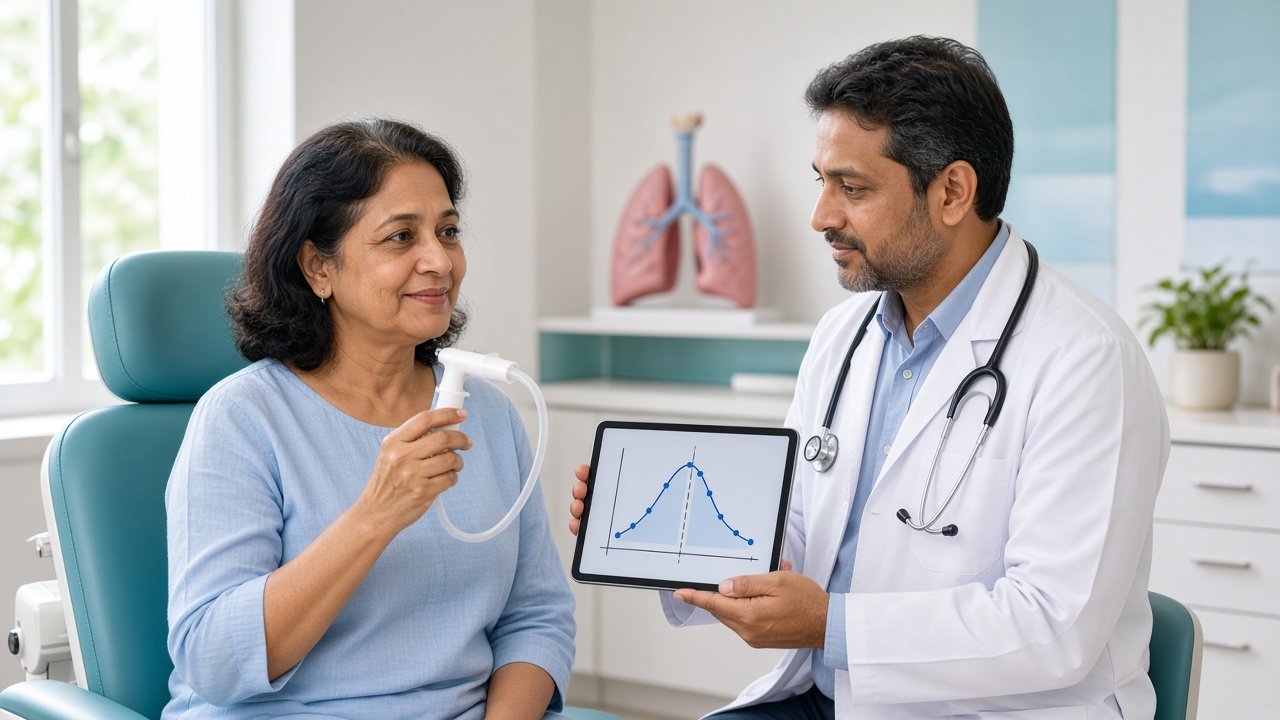
A spirometry test is the essential breathing test for COPD diagnosis. You sit upright, wear a nose clip, seal your lips around a mouthpiece, fill your lungs, and blow out as hard and as fast as you can until the lungs feel empty. The effort is repeated so the result is reliable. A bronchodilator, a reliever inhaler, is then given. After it has had time to work, the blows are repeated.
The post-bronchodilator result is the one that matters for COPD. If the narrowing disappears after the inhaler, the picture fits asthma more than COPD. The test should not be done when you are acutely unwell, because a chest infection can temporarily worsen the numbers.
A schematic volume–time curve. It is not a patient report. FEV1 is the air exhaled in the first second. FVC is the total air exhaled.
How the test feels
- 1Sit upright, with a soft clip on the nose so air does not leak.
- 2Seal your lips around the mouthpiece and breathe out gently, then in, until the lungs feel full.
- 3Blast the air out as hard and as fast as you can, until nothing more will come.
- 4Repeat until the efforts match. Then use a reliever inhaler and repeat the blows.
The number used to confirm airflow obstruction is the result after the inhaler, not the first blow alone.
FEV1
Forced expiratory volume in one second. The amount of air you can force out in the first second of the blow. Narrow airways lower this number.
FVC
Forced vital capacity. The total amount of air you can force out after a full breath in. It reflects the usable size of the breath.
FEV1/FVC
The ratio of the two. In healthy lungs most of the air leaves in the first second, so the ratio is usually well above 0.70.
The result that confirms airflow obstruction
A post-bronchodilator FEV1/FVC below 0.70 confirms airflow obstruction in the appropriate clinical context. That context means typical symptoms together with a relevant exposure or history, interpreted by a clinician. The ratio is not a label you apply to yourself from a single printout.
GOLD uses this fixed ratio because it is practical and widely available. It has limits. Some older adults fall below 0.70 without the same disease pattern, and some younger adults have real obstruction while the ratio is still above 0.70. Once obstruction is confirmed, FEV1 compared with the predicted value helps describe severity. The inhaler plan still depends on how breathless you are and how often you have flare-ups, not on the percentage alone.
Spirometry is also used later, to see whether treatment and stopping smoke are holding the line. It is different from a peak-flow meter at home, which is a simpler tool and cannot diagnose COPD. For how the result is turned into a treatment plan, see the asthma and COPD clinic page.
COPD treatment
COPD treatment aims to ease symptoms, reduce flare-ups, and slow further loss of lung function. It does not rebuild destroyed air sacs. The plan is personal. Two people with the same FEV1 may need different inhalers if one is rarely breathless and the other is in hospital twice a year. A practical starting point for daily life is also covered in the guide to living with COPD.
Inhaler therapy
Inhalers are the main day-to-day COPD treatment. Long-acting bronchodilators relax the airways for many hours and are the usual maintenance treatment. A short-acting reliever is kept for sudden tightness. Inhaled steroids are added only for selected people, such as those with repeated flare-ups or features of asthma, because they are not helpful for everyone and can raise the chance of pneumonia. How you inhale matters as much as which inhaler you hold. Bring your devices to each visit so the technique can be checked, and rinse your mouth after a steroid inhaler.
Smoking cessation
Stopping smoking is the single most effective step to slow COPD. Lung function does not return to normal, but the faster yearly decline seen in people who keep smoking becomes closer to the decline of ageing. It is still worth stopping after the diagnosis, and after a hospital admission. Counselling, nicotine replacement, and other stop-smoking medicines can be discussed if willpower alone has not been enough. The same principle applies to biomass smoke: a chimney, a cleaner fuel, or better kitchen ventilation lowers the dose of smoke the lungs receive.
Pulmonary rehabilitation
Pulmonary rehabilitation is a supervised programme of walking and strength exercise, breathing practice, education, and nutrition advice. It is one of the most effective treatments for breathlessness and confidence, including for people who feel too limited to exercise alone. It does not replace inhalers. Home breathing practice, such as pursed-lip breathing, supports the programme but is not a full substitute for it.
Vaccination
Infections are a common trigger for COPD flare-ups. Vaccines do not treat COPD itself. They lower the chance of some of those infections. Ask which of these apply to you: the yearly influenza vaccine, pneumococcal vaccines, a COVID-19 vaccine, and, for some adults, RSV, whooping-cough (Tdap), or shingles vaccines. The right set depends on age and other illnesses.
Oxygen therapy
Oxygen is prescribed only after a blood gas or a formal oxygen check shows that levels are low enough to need it. That is often when saturation stays at or below about 88 percent at rest, or in a few other situations a doctor will explain, such as a drop during walking or sleep. Feeling breathless with a normal oxygen level is not, by itself, a reason to start oxygen. Using oxygen without testing can be harmful. When long-term oxygen is truly needed for severe resting low oxygen, it can help people live longer. It is used for the number of hours prescribed, including during sleep.
Advanced treatment options
A smaller group of people with severe COPD is assessed for treatments beyond inhalers. These can include non-invasive breathing support at home for selected patients with chronically high carbon dioxide, procedures or surgery to reduce trapped air in severe emphysema, removal of a large bulla, or, rarely, transplant assessment. None of these is a cure, and none is a first step. They are considered only after smoking cessation, inhalers, rehabilitation, and treatment of other illnesses have been addressed.
Other illnesses travel with COPD: heart disease, weak muscles, low mood, anxiety about breathing, and poor sleep. Treating those is part of COPD care, not a side issue. Loud snoring and unrefreshing sleep may need a separate look. The sleep medicine service explains when a sleep study is useful. Procedures that reduce trapped air in selected severe emphysema sit with interventional pulmonology, after the basics of treatment are already in place.
COPD exacerbations and emergency warning signs
An exacerbation, or flare-up, is a sustained worsening beyond the usual day-to-day ups and downs. Breathlessness increases, cough increases, or the sputum becomes more in amount, thicker, or more yellow or green. A flare-up may follow a cold, a pollution spike, or missed inhalers. Each serious flare-up can leave lung function a little worse than before, which is why early treatment matters.
Call the clinic promptly if your usual symptoms are climbing and you are still able to speak, walk a little, and use your inhalers. Do not start steroid tablets or antibiotics on your own unless your pulmonologist has already given you a written action plan that says when to use them.
Seek emergency care now if you have
- Breathlessness at rest, or trouble finishing a sentence
- Lips, tongue, or fingertips turning blue or grey
- Confusion, unusual drowsiness, or agitation
- Chest pain
- Coughing up more than small streaks of blood
- A reliever inhaler that is no longer helping at all
- High fever with breathing that is worsening quickly
These are emergency warning signs. Go to an emergency department. Do not wait for the next outpatient appointment. For a non-emergency appointment, call +91 79721 73176.
Prevention and lung health tips
You cannot change damage that is already done. You can lower the dose of injury from today onward, whether or not you already have COPD.
- Do not start smoking. If you smoke, stop, and keep other people's smoke out of the house.
- If you cook on biomass fuel, improve ventilation or move to a cleaner fuel when you can.
- On high air-quality-index days, shift hard exercise indoors and keep windows shut at peak hours.
- Use the dust protection your workplace provides, and ask for it if it is missing.
- Walk most days, at a pace you can still talk through, unless your doctor has limited activity.
- Eat enough protein. Both marked weight loss and extra weight make breathing harder.
- Take inhalers as prescribed, and bring them to appointments so technique can be checked.
- Stay up to date with the vaccines your doctor recommends.
- Wash hands and keep some distance from people with chest infections.
- Know your flare-up plan before the next one starts.
Short practices such as pursed-lip breathing help some people recover from a burst of breathlessness. They are explained in the breathing exercises article. They support treatment. They do not replace a diagnosis.
World COPD Day 2026: a better life starts with a clearer diagnosis
The point of World COPD Day is not fear. It is a better life through earlier diagnosis and steady management. COPD will still be there tomorrow if it is there today. What can change is how early it is named, how well the inhalers are used, and how rarely a flare-up ends in hospital.
If a cough has lasted for weeks, if walking has quietly become harder, or if someone in the family has cooked over smoke or smoked for years, a spirometry test is a reasonable next step. You do not need to decide the diagnosis yourself before you book. That is the pulmonologist's work.
There is no cure to promise. There is care that helps people stay involved in their own days: work, family, prayer, a walk. That is a worthwhile aim for 18 November 2026, and for the months after it.
Medical disclaimer
This page is general education for World COPD Day 2026. It follows widely used evidence, including the GOLD report on COPD diagnosis and management, and the World Health Organization description of COPD as a major cause of illness and death. It is not personal medical advice, and it does not create a doctor–patient relationship. COPD treatment is individual. Do not start, stop, or change inhalers, oxygen, antibiotics, or steroid tablets based on this article. Oxygen and advanced procedures are prescribed only after proper testing. If you have severe breathlessness, chest pain, blue lips, or confusion, seek emergency care. For a consultation, book with Dr. Chaitanya Kappagantu or call +91 79721 73176.
Further reading: GOLD and the WHO COPD fact sheet.
About the specialist

Dr. Chaitanya Kappagantu
Consultant Interventional Pulmonologist & Sleep Specialist
MBBS, MD (Pulmonary Medicine), Diploma in Pediatric Pulmonology, and Fellowship in Interventional Pulmonology. He consults at Medicover Hospitals, Secunderabad, and Idea Clinics, Kukatpally, with a practice centred on evidence-based respiratory care.
- COPD and asthma management
- Spirometry and breathlessness evaluation
- Chronic cough and chest infections
- Bronchoscopy and interventional pulmonology
- Sleep apnea and sleep medicine
- Long-term respiratory follow-up
Medicover Hospitals, Sarojini Devi Rd, Regimental Bazaar, Shivaji Nagar, Secunderabad, Telangana 500003. Monday - Saturday, 10:00 AM - 4:00 PM.
Idea Clinics, Triveni Towers, Rd Number 1, Kukatpally Housing Board Colony, Hyderabad, Telangana. Monday - Saturday, 5:30 PM - 8:00 PM.
Questions patients ask
Answers below are the same information used for the FAQ structured data on this page.
What is World COPD Day 2026?
World COPD Day is the annual awareness day for chronic obstructive pulmonary disease, held on the third Wednesday of November. In 2026 that date is 18 November. This article focuses on early diagnosis and management for a better life: recognising symptoms, confirming COPD with spirometry, and starting care before the disease is advanced.
What are the early symptoms of COPD?
The usual early COPD symptoms are a cough that does not settle, regular sputum, breathlessness on stairs or hills, wheezing, and getting tired sooner than before. They build slowly, so they are easy to blame on age, fitness, or a smoker's cough.
How is COPD diagnosed?
COPD diagnosis needs more than a chest X-ray. A pulmonologist looks at your symptoms, smoke or dust exposure, and examination, then confirms airflow obstruction with a spirometry test. In the appropriate clinical context, a post-bronchodilator FEV1/FVC below 0.70 confirms airflow obstruction.
What is a spirometry test?
A spirometry test measures how fast and how much air you can blow out. You seal your lips around a mouthpiece, take a full breath in, and blast the air out. The test is repeated after a reliever inhaler. It reports FEV1, FVC, and the FEV1/FVC ratio. It is painless and is done in the clinic.
Can COPD be cured?
No. COPD cannot be cured, and damaged air sacs do not grow back. Quitting smoking, reducing kitchen and outdoor smoke, using the right inhalers, joining pulmonary rehabilitation, staying vaccinated, and treating flare-ups early can ease symptoms, cut hospital visits, and slow further loss of lung function.
Where can I get COPD treatment in Hyderabad?
Dr. Chaitanya Kappagantu, Consultant Interventional Pulmonologist and Sleep Specialist, sees patients for COPD treatment in Hyderabad at Medicover Hospitals, Sarojini Devi Rd, Regimental Bazaar, Shivaji Nagar, Secunderabad, Telangana 500003, Monday to Saturday, 10:00 AM - 4:00 PM, and at Idea Clinics, Triveni Towers, Rd Number 1, Kukatpally Housing Board Colony, Hyderabad, Telangana, Monday to Saturday, 5:30 PM - 8:00 PM. Call +91 79721 73176 or use the appointment page to book.
I have never smoked. Can I still have COPD?
Yes. In India, years of biomass smoke from a wood or dung stove, outdoor air pollution, workplace dust, previous tuberculosis, and severe childhood chest infections can all lead to COPD in people who have never smoked. Spirometry can check whether the airways are obstructed.
When is COPD breathlessness an emergency?
Seek emergency care the same day if breathlessness is present at rest, you cannot finish a sentence, your lips or fingers turn blue or grey, you are confused or unusually drowsy, you have chest pain, you cough up more than streaks of blood, or your reliever inhaler is no longer helping. Do not wait for a routine clinic visit.
Related articles
.jpg)
COPD
Living with COPD: A Complete Guide to Better Breathing
Inhaler technique, breathing practice, flare-up planning, and day-to-day COPD care.
Lung Health
10 Warning Signs of Lung Disease You Shouldn't Ignore
Cough, breathlessness, chest pain, and other symptoms that need a prompt review.
Wellness
5 Breathing Exercises to Strengthen Your Lungs at Home
Pursed-lip and belly breathing you can practise between clinic visits.